Most cold calling scripts for real estate are one script with the address swapped. That falls apart by the second call of the night. An owner with a sale date on the calendar, a son clearing out his late mother's house, and a landlord on her third eviction are not having the same week, and they should not hear the same pitch.
This page has 8 real estate cold calling scripts, one per lead type. Every script uses the same fields in the same order, so you can compare them and train a new caller on the pattern, not just the words. I run a wholesale acquisitions team on ForesightCRM, and ForesightCRM is our product. The scripts work in any dialer, and I show how we run them near the end.
- 8 lead types, 7 fields each: who the lead is, what they are dealing with, the opener, 3 or 4 questions, the likely objection with a reply, a compliance note, and what to log.
- 8am to 9pm on their clock: the federal rule limits telephone solicitations to those hours at the called person's location (47 CFR 64.1200), and some states are stricter.
- 10 business days: under the same rule, a request to stop calling must be honored within that time and kept on your own do-not-call list for 5 years.
Real estate cold calling scripts at a glance
Swipe the table sideways to see every column.
| Lead type | Who they are | Opener angle | Key question | Likely objection | Compliance note | What to log |
|---|---|---|---|---|---|---|
| 1. Pre-foreclosure | Owner with a default or sale notice | Local buyer, not the lender | "Where do things stand with your lender?" | "I'm working it out with the bank." | Never promise to stop the sale; point to free HUD-approved counselors | Sale date, days to auction, lender status |
| 2. Tax delinquent | Owner behind on property taxes | Private buyer, not the county | "Is there a mortgage, or is it paid off?" | "I'm going to pay the taxes." | Never imply you work for the county | Years behind, tax sale date, mortgage status |
| 3. Inherited property | An heir to a family member's house | Condolences, then ask if now is okay | "Are you the person handling the house?" | "It's too soon." | No legal or tax advice; offer to stop calling | Who can sign, other heirs, agreed check-back date |
| 4. Vacant property | Owner of a house nobody lives in | Confirm the owner, then ask about the house | "What's the plan for it?" | "I'll fix it up someday." | Relatives answer; scrub every number | Occupancy, why it's empty, condition |
| 5. Absentee owner | Owner whose mailing address is elsewhere | Ask if they still own it | "How are you using the house right now?" | "I'm happy with the rent." | Call by the owner's time zone | Owner's time zone, use, years owned |
| 6. Tired landlord | Rental owner worn down by tenants or repairs | Buyer of rentals in their city | "Is the tenant paying?" | "Not at an investor price." | Ask about the lease, never who the tenants are | Rent, lease end, the number they need |
| 7. Expired or withdrawn listing | Owner whose listing ended without a sale | Direct buyer; still thinking about selling? | "Are you still working with an agent?" | "I'm relisting with my agent." | Step back if a listing agreement is active | Agent status, last price, why it didn't sell |
| 8. Code violation | Owner with an open city code case | As-is buyer, not the city | "Is the notice something you're working on?" | "I don't need more pressure." | Never imply you work for the city | Case type, deadline, repair estimate |
Rules every script on this page follows
- Scrub every list before you dial. Check numbers against the National Do Not Call Registry and your own internal do-not-call list. Courts disagree on whether an offer to buy a house is a telephone solicitation at all, so scrub anyway. Our guide to whether it is legal to text motivated sellers walks through the same federal rules that cover calls.
- Call on the seller's clock. Respect calling hours in the seller's time zone, which may not match the property's. The federal window is 8am to 9pm local time, and state rules can be tighter, so check yours.
- Say who you are, and who you are not. Give your name, your company, and that you buy houses. Never suggest you are the lender, the county, the city, or a court.
- Confirm the owner before you name the problem. Skip-traced numbers reach relatives, tenants, and past owners. Keep words like foreclosure, taxes, and violation out of the call until the person confirms they own the house.
- No promises, no advice. Never promise to stop a foreclosure, clear a tax debt, or close a code case. Do not give legal, tax, or financial advice. Point people to a free HUD-approved housing counselor, an attorney, or a tax professional.
- No means done. If someone is not interested, thank them and end the call. If they ask not to be called, add the number to your internal do-not-call list that day.
- AI callers need consent. AI voice calls to cell phones and home phones need the called person's prior express consent. In its February 8, 2024 ruling, the FCC confirmed that AI-generated voices are artificial voices under the TCPA. These scripts are for people dialing, not for an AI caller working a cold list.
Three replies every caller needs
| They say | You reply | Then |
|---|---|---|
| "How did you get my number?" | "Fair question. Ownership is public record, and we use a data service to find owner phone numbers. If you'd rather I not call, I'll take you off my list right now." | Same on every list. If they ask to be removed, treat it as a do-not-call request. |
| "Not selling." | "Understood, and thanks for telling me. I won't call again. Wishing you the best." | No "are you sure?" and no call next month. |
| "Stop calling me" or "take me off your list" | "Done. You're off our list, and you won't get more calls from us." | Add the number to your internal do-not-call list that day. If they also asked for no texts, pull it from text lists too. |
1. Pre-foreclosure, by days to auction
Who this lead is: An owner in foreclosure, found on a recorded default or sale notice. See how to find foreclosure leads before auction.
What they are dealing with: Lender letters, other buyers calling, and a sale date getting closer. Days to auction sets your tone: past 60 days, ask and listen. Inside 30, name the date once, plainly. In the final week, keep it short.
Opener:
Hi, is this [Name]? This is [Your name] with [Company]. I'm a local home buyer, not your lender, calling about [Address]. Are you the owner?
Once they confirm: "I saw a notice on the house, and I'm sorry you're dealing with that. Got two minutes?"
Questions:
- "Where do things stand with your lender?"
- "Is [Sale date] still the date you have?"
- "Would you rather keep the house or sell it?"
- "Have you talked with a HUD-approved housing counselor? They're free."
Most likely objection: "I'm working it out with the bank."
Reply: "Good, I hope it works. If anything changes before [Sale date], you have my number. I won't keep calling."
Compliance note: Never promise to stop or postpone the sale, or tell anyone to avoid their lender. Point them to the CFPB's housing counselor finder. Some states regulate contact with owners in foreclosure, so have a local attorney read your script.
What to log: Sale date and source, days to auction, lender status, the keep-or-sell answer, and a call-back date before the sale.
2. Tax delinquent
Who this lead is: An owner behind on property taxes, pulled from the county's delinquent tax list.
What they are dealing with: Penalties and interest that keep growing, county notices, and in some places a tax sale on the calendar. Some of these houses are paid off, so the tax bill may be the whole problem.
Opener:
Hi, this is [Your name] with [Company]. I'm a private home buyer, not the county, calling about [Address]. Is this the owner?
Questions:
- "Do you live there, or is it a property you hold?"
- "Is the tax bill something you're already working on with the county?"
- "Is there a mortgage on it, or is it paid off?"
- "What would make selling worth it to you?"
Most likely objection: "I'm going to pay the taxes."
Reply: "That makes sense. The county tax office can give you the exact payoff and any payment plan. If you ever want a number on the house to compare, call me."
Compliance note: Never say or suggest you are calling from the county or the tax collector. The FTC's impersonation rule bars falsely posing as, or implying ties to, any government, local included (16 CFR Part 461). Don't quote penalties, redemption rights, or sale rules; send them to the county.
What to log: Years behind from the county list, any tax sale date, mortgage or free and clear, who lives there, and their plan for the bill.
3. Inherited property (an heir)
Who this lead is: Someone who inherited, or expects to inherit, a family member's house. You are calling the heir, not working a court filing list.
What they are dealing with: Grief, a house full of belongings, bills, maybe siblings who disagree, and questions about who can sign. If there is a mortgage, the CFPB has documented heirs' trouble with mortgage servicers.
Opener:
Hi, is this [Name]? This is [Your name] with [Company]. I buy houses locally, and I'm calling about [Address]. I'm sorry for your loss. Is now an okay time, or should I call another day?
Questions:
- "Are you the one handling the house?"
- "Who else in the family is part of the decision?"
- "Would you like to keep it, rent it, or sell it?"
- "Is anything pressing, like a mortgage, taxes, or an empty house?"
Most likely objection: "It's too soon to talk about this."
Reply: "I understand, and I'm sorry to call at a hard time. Can I check back in a few months, or would you rather I not call again?"
Compliance note: Don't tell an heir who can sign, how to split proceeds, or how taxes on an inherited house work. That is for an estate attorney or a tax professional. If they ask you not to call again, honor it.
What to log: Who can sell, other decision-makers, what is pressing, and a check-back date a few months out, if they agreed to one.
4. Vacant property
Who this lead is: The owner of a house that looks empty: mail piling up, utilities off, or a vacancy flag on your list.
What they are dealing with: Taxes, insurance, and upkeep on a house nobody lives in, plus break-in and weather risk. The owner may have moved, gone into care, passed away, or stalled on repairs.
Opener:
Hi, this is [Your name] with [Company]. I buy houses locally, and I'm calling about [Address]. Am I speaking with the owner?
Questions:
- "Is anyone living there right now?"
- "What's the plan for it: move back, rent it, fix it, or sell it?"
- "What would it need before someone could live there?"
- "Who else would be part of a decision to sell?"
Most likely objection: "I'm going to fix it up myself someday."
Reply: "That's a good plan. If someday turns into a while, I'm happy to give you a number to compare against. Can I check back in a few months?"
Compliance note: Vacant lists reach relatives and caretakers. If someone says the owner passed away, slow down and switch to the inherited script. The owner's number may be a personal cell, so scrub it against the National Do Not Call Registry like any other. Stay off the property; never go in or look in windows.
What to log: Who lives there, why it is empty, condition, other decision-makers, and any check-back date they agreed to.
5. Absentee owner
Who this lead is: An owner whose mailing address is somewhere other than the property, often in another city or state.
What they are dealing with: Running a house from a distance: tenants, repairs, and bills handled by phone. Some like the rental income. Others are tired of it and nobody has asked them about selling.
Opener:
Hi, this is [Your name] with [Company]. I buy houses in [City], and I'm calling about [Address]. Do you still own it?
Questions:
- "How are you using the house right now: rental, family, or empty?"
- "How long have you owned it?"
- "How is managing it from [Their city] going?"
- "If you sold, would you want a quick as-is sale or top dollar on the market?"
Most likely objection: "I'm happy with the rent it brings in."
Reply: "Glad it's working for you. I'll leave you be. If that ever changes, I'm [Your name] with [Company]."
Compliance note: Calling hours run on the owner's clock, not the property's. The federal rule limits telephone solicitations to 8am to 9pm at the called person's location (47 CFR 64.1200), so call by the owner's time zone, and check whether their state is stricter.
What to log: The owner's time zone, how they use the property, years owned, the quick-sale or top-dollar answer, and the next touch if they asked for one.
6. Tired landlord
Who this lead is: A rental owner worn down by the property, often spotted through an eviction filing, a code complaint, or a long gap between tenants.
What they are dealing with: Late rent, repairs, turnover, and sometimes an eviction. Some are accidental landlords who rented out an old home and never wanted the job.
Opener:
Hi, this is [Your name] with [Company]. I buy rental houses in [City], and I'm calling about [Address]. Are you the owner?
Questions:
- "Is it rented right now, and when does the lease end?"
- "What does it rent for, and is the tenant paying?"
- "What's the biggest headache with it right now?"
- "Would you sell it with the tenant in place?"
Most likely objection: "I'd sell, but not at an investor price."
Reply: "Fair enough. Tell me what you need to walk away with, and I'll tell you honestly whether I can get close. If I can't, I'll say so."
Compliance note: Keep tenant questions to rent, lease dates, and condition, never who the tenants are. The Fair Housing Act bars housing discrimination because of race, color, national origin, religion, sex, familial status, or disability (HUD). Don't promise to remove a tenant. The lease and local law decide that.
What to log: Rent, lease end, payment status, repairs, the number they need to net, and whether they would sell occupied.
7. Expired or withdrawn listing
Who this lead is: An owner whose listing expired or was pulled from the market without selling.
What they are dealing with: They wanted to sell and it did not happen, because of price, condition, or timing. Agents and buyers may all be calling at once, and a withdrawn listing can still be under a listing agreement.
Opener:
Hi, is this the owner of [Address]? This is [Your name] with [Company]. I buy houses directly, and I saw it came off the market. Are you still thinking about selling?
Questions:
- "Are you still working with an agent on it?"
- "What do you think kept it from selling?"
- "Do you still need to sell, and by when?"
- "What price would make a sale work for you?"
Most likely objection: "I'm relisting with my agent."
Reply: "Then stay with your agent, and I hope it sells fast. If it doesn't and you want an as-is option later, call me."
Compliance note: If they are still under a listing agreement, send them back to their agent and end the call. If you hold a license, the NAR Code of Ethics bars Realtors from soliciting a listing held exclusively by another broker (Standard of Practice 16-4), and your state's license rules apply too.
What to log: Agent status and the agreement's end date if they know it, last list price, days on market, why they think it did not sell, and their timeline.
8. Code violation
Who this lead is: An owner with an open city code case, such as an unsafe structure, overgrowth, or junk on the lot. Some cities publish these cases as open data, like Chicago's Building Violations dataset.
What they are dealing with: City notices, deadlines to fix, possible fines, and repairs they may not be able to pay for.
Opener:
Hi, this is [Your name] with [Company]. I buy houses as-is in [City], and I'm not with the city. I'm calling about [Address]. Are you the owner?
Questions:
- "Is anyone living there right now?"
- "Is the city's notice something you're already working on?"
- "What would it take to fix, and do you want to take that on?"
- "If you sold it as-is, how soon would you want to close?"
Most likely objection: "The city's already on me. I don't need more pressure."
Reply: "Understood, and I won't add any. If selling as-is would take this off your plate, I can give you a straight number. If not, I'll leave you be."
Compliance note: Never say or suggest you are with the city or can make the case go away. The same FTC impersonation rule covers posing as a local government. Don't quote fines or deadlines. Send them to the code office for exact terms.
What to log: Violation type and case number, the deadline, who lives there, a rough repair estimate, and their timeline.
Mistakes that burn a calling list
- Dialing a list nobody scrubbed against the National Do Not Call Registry and your own do-not-call list.
- Calling by the property's time zone instead of the owner's.
- Naming the foreclosure, the tax bill, or the code case before the person confirms they own the house.
- Promising an outcome: a stopped sale, a cleared tax debt, a closed code case.
- Giving legal, tax, or financial advice instead of pointing to a counselor, an attorney, or a tax professional.
- Calling back after a clear no, or after "don't call me." That request belongs on your do-not-call list.
- Pointing an AI voice caller at a cold list. AI voice calls need the called person's prior express consent.
- Hanging up without notes. What you log is the script for the next call.
How we run these scripts in ForesightCRM
My team runs these scripts on ForesightCRM (facts from our feature and pricing pages, November 26, 2026).
- A dialer on every plan. The power dialer comes with 1 to 15 phone numbers by tier. Click-to-call puts the lead's score, property, and history beside the dial pad.
- Log it in one tap. Eleven dispositions and outcomes log instantly and trigger the next step.
- Coach on real calls. Calls are recorded, transcribed, and searchable, with barge, whisper, and monitor. Growth adds AI call grading.
- An AI caller for consented leads. The optional AI Voice Agent ($299 per month, 500 talk minutes, then $0.50 per minute) loads your scripts into its knowledge base, calls inside windows you set per time zone, and warm-transfers interested sellers. AI voice calls to cell phones need prior express consent.
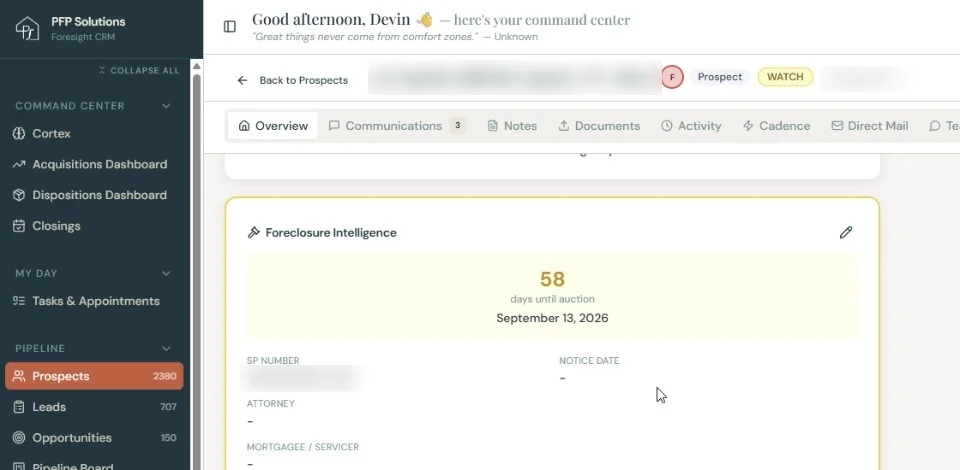
Real screen: a lead in our pipeline, 58 days until auction. Owner details blurred.
The bottom line on real estate cold calling scripts
Good real estate cold calling scripts sound like one real person who knows why they are calling, says who they are, asks real questions, and takes no for an answer. The lead type tells you which questions to ask. The respect keeps the door open for a seller who calls you back later.
Copy these, put them in your own words, and have a TCPA attorney in your state look them over. If you want the dialer, recordings, and dispositions in one place, start the 14-day Foresight trial. You can cancel anytime.
ForesightCRM is our product. Foresight claims are from our power dialer, AI Voice Agent, and pricing pages as of November 26, 2026. Legal and public sources (the FCC, eCFR, the FTC, the CFPB, HUD, the NAR Code of Ethics, and the City of Chicago) are linked where cited and were checked the same day. This is not legal advice. If something has changed, tell us and we will correct it.
Changelog: November 27, 2026, published.