- 22 questions, 7 stages. Opener, motivation, condition, numbers and mortgage, timeline, decision makers, and close, in the order a real call runs.
- 5 fixed fields per question. The words to say, why you ask it, what a good answer sounds like, the follow-up if they dodge, and the CRM field it fills.
- 5 questions for a short call. Numbers 1, 4, 10, 14, and 17 tell you whether there is a deal when a seller has two minutes.
A seller call usually goes sideways in one spot: the price question comes before the seller knows who is calling or why it matters. The questions were fine. The order was wrong.
This list puts the questions to ask motivated sellers in the order a call actually runs. Every question carries the same five fields, so the answers land in your CRM instead of a notebook. I run a wholesale operation on ForesightCRM, and ForesightCRM is our product. The questions work in any CRM, and I show where we keep the answers near the end.
All 22 questions at a glance
| # | Stage | Question | CRM field it fills |
|---|---|---|---|
| 1 | Opener | Are you the owner of the house? | Contact role |
| 2 | Opener | Is now an okay time to talk? | Callback time |
| 3 | Opener | Have you thought about selling? | Interest level |
| 4 | Motivation | What has you thinking about selling? | Motivation |
| 5 | Motivation | What would a good outcome look like for you? | Seller priorities |
| 6 | Motivation | Have you talked to an agent or had other offers? | Other options |
| 7 | Condition | Do the beds, baths, and size on record sound right? | Beds, baths, square feet |
| 8 | Condition | What work does the house need? | Repairs and updates |
| 9 | Condition | Who is living there right now? | Occupancy |
| 10 | Numbers and mortgage | Is there a mortgage, and about how much is left? | Mortgage balance |
| 11 | Numbers and mortgage | Are the payments up to date? | Payment status |
| 12 | Numbers and mortgage | Is anything else tied to the house? | Other liens and taxes |
| 13 | Numbers and mortgage | Do you have a price in mind? | Asking price and its source |
| 14 | Timeline | When would you like to be done with the house? | Target date |
| 15 | Timeline | Is there a date you're working against? | Hard deadline |
| 16 | Timeline | What has to happen before you can move? | Move-out needs |
| 17 | Decision makers | Whose names are on the deed? | Owners on title |
| 18 | Decision makers | Who else will weigh in on the decision? | Other decision makers |
| 19 | Decision makers | Does anything have to be settled before a sale? | Authority to sell |
| 20 | Close | Is anything else holding you back? | Concerns |
| 21 | Close | Can I see the house Thursday or Saturday? | Appointment or next follow-up |
| 22 | Close | What questions do you have for me? | Seller questions and promises |
Stage 1: Opener questions (1 to 3)
If the conversation started by text, our pre-foreclosure text message scripts cover the messages before this call, and is it legal to text motivated sellers covers consent.
1. Are you the owner of the house?
- Say it: "Hi, is this [Name]? This is [Your name] with [Company]. I buy houses locally and I'm calling about [Address]. Are you the owner?"
- Why you ask it: Skip-traced numbers reach adult children, tenants, and past owners. Confirm who you have before you say anything sensitive about the property.
- A good answer sounds like: "Yes, that's mine." Or "It was my dad's. I'm handling it for the family."
- If they dodge: "No problem. Is there someone I should talk to about the house, or would you like me to take this number off my list?"
- CRM field it fills: Contact role (owner, family member, tenant, wrong number).
2. Is now an okay time to talk?
- Say it: "Did I catch you at an okay time, or is there a better time for a ten-minute call?"
- Why you ask it: A seller who is driving or at work gives short answers. Book callbacks inside legal hours: the federal rule bars telephone solicitations before 8am or after 9pm in the called person's local time (47 CFR 64.1200(c)(1)), and some states set tighter limits. Calling around a day job? See our weekly plan for wholesaling with a full-time job.
- A good answer sounds like: "I've got a few minutes." Or "Call me after 6."
- If they dodge: "Would tonight at 6:30 or tomorrow at noon work better?"
- CRM field it fills: Callback time.
3. Have you thought about selling?
- Say it: "Have you thought about selling the house, or did my call come out of nowhere?"
- Why you ask it: It sets the baseline before you spend ten minutes on questions. The "out of nowhere" part gives them an easy, honest way to say no, and a no ends the call politely.
- A good answer sounds like: "We've talked about it." Or "Not really, but it depends on the number."
- If they dodge: "Fair enough. Is it a hard no, or something you'd think about down the road? If it's a no, I'll take you off my list."
- CRM field it fills: Interest level (not selling, open to it, wants to sell).
Stage 2: Motivation questions (4 to 6)
4. What has you thinking about selling?
- Say it: "What has you thinking about selling?"
- Why you ask it: The reason drives everything after it: how fast they need to move, how flexible the price is, and whether a quick cash sale even helps them. Someone selling a parent's house needs something different from someone relocating for work.
- A good answer sounds like: "My mom passed in the spring, and none of us live nearby." Or "I got a job in Charlotte and start in March."
- If they dodge: "Is it more about the house itself, or something going on in life?" If they mention a loss, start with "I'm sorry," then keep going gently.
- CRM field it fills: Motivation (the reason, in their words).
5. What would a good outcome look like for you?
- Say it: "If this all worked out, what would a good outcome look like for you?"
- Why you ask it: Sellers weigh more than price: speed, skipping repairs, not cleaning out decades of belongings, privacy. Knowing what matters most tells you what your offer has to solve.
- A good answer sounds like: "Honestly, I just don't want to deal with the repairs or the cleanout."
- If they dodge: "Is it more about the price, the timing, or not having to deal with the house?"
- CRM field it fills: Seller priorities.
6. Have you talked to an agent or had other offers?
- Say it: "Have you talked to an agent, listed it before, or had other offers?"
- Why you ask it: It shows what else the seller is weighing. A house that sat on the market tells you something different from one that was never listed, and other offers give you a sense of the range.
- A good answer sounds like: "We listed it last year for 90 days and it didn't sell." Or "Two other investors called. I didn't like their numbers."
- If they dodge: "No worries. Are you open to listing it, or would you rather sell direct?"
- CRM field it fills: Other options (listing history, other offers).
Stage 3: Condition questions (7 to 9)
7. Do the beds, baths, and size on record sound right?
- Say it: "The county shows [Beds] bedrooms, [Baths] baths, and about [Square feet] square feet. Does that sound right?"
- Why you ask it: Public records miss finished basements, additions, and converted garages, and sometimes list the wrong count. Your comps depend on getting this right.
- A good answer sounds like: "Close. We finished the basement, so there's a fourth bedroom down there."
- If they dodge: "No problem, we can check it when I see the house. Has anything been added since you bought it?"
- CRM field it fills: Beds, baths, square feet (confirmed or not).
8. What work does the house need?
- Say it: "What work does the house need, and what has been updated? Roof, heating and air, water heater, plumbing, electrical?"
- Why you ask it: Repairs move your number a lot, and naming the big systems gets specifics instead of "it needs some TLC."
- A good answer sounds like: "The roof is about 20 years old, the furnace is from 2019, and the kitchen is original."
- If they dodge: "If you were staying ten more years, what would you fix?"
- CRM field it fills: Repairs and updates (system, age, notes).
9. Who is living there right now?
- Say it: "Who's living there right now: you, family, a tenant, or is it empty?"
- Why you ask it: Occupancy changes access, the timeline, and the deal. A tenant may have a lease that runs past your closing date, a vacant house may need to be secured, and an owner who lives there needs somewhere to go.
- A good answer sounds like: "A tenant, month to month, paying $1,100." Or "It's been empty since my mom moved to assisted living."
- If they dodge: "Would we be able to see the inside if we set up a time?"
- CRM field it fills: Occupancy (owner, family, tenant, vacant) and lease terms.
Stage 4: Numbers and mortgage questions (10 to 13)
10. Is there a mortgage, and about how much is left?
- Say it: "Is there a mortgage on the house? A ballpark is fine. About how much is left on it?"
- Why you ask it: The payoff is the floor. If what's owed is more than you could pay, a simple purchase doesn't work, and it's better for both of you to know that now.
- A good answer sounds like: "About $86,000. I can check the last statement."
- If they dodge: "That's fair. Is it closer to paid off, or closer to what you bought it for?"
- CRM field it fills: Mortgage balance (seller estimate).
11. Are the payments up to date?
- Say it: "Are the payments current, or has it fallen behind? No judgment either way. It changes how fast things need to happen."
- Why you ask it: Missed payments can mean a foreclosure is underway, with a sale date that sets the real timeline. If they're behind, mention once that HUD-approved housing counselors are free and point to the CFPB's housing counselor finder. Don't tell them what to do about the loan.
- A good answer sounds like: "We're three months behind. We got a letter last month."
- If they dodge: "Okay. Have you gotten any letters from the lender or the county about the house?"
- CRM field it fills: Payment status (current, behind, months behind).
12. Is anything else tied to the house?
- Say it: "Is anything else tied to the house, like a second loan, a home equity line, back taxes, or a lien?"
- Why you ask it: A title search will find them anyway. Hearing about them now keeps your offer honest and keeps the seller from a surprise at closing.
- A good answer sounds like: "There's a home equity line, maybe $15,000, and I owe last year's taxes."
- If they dodge: "Title will check either way. I'd rather plan for it now than surprise you later."
- CRM field it fills: Other liens and taxes (type, estimate).
13. Do you have a price in mind?
- Say it: "Do you have a price in mind? How did you land on that number?"
- Why you ask it: The second half matters more. A neighbor's sale, a tax assessment, or the loan payoff each leads to a different conversation. Asking here, after condition, means you both have the repairs in mind. Don't quote your own number until you've run it.
- A good answer sounds like: "I'd want $180,000. The house down the street sold for $210,000, but ours needs a roof."
- If they dodge: "That's okay. What would you need to walk away with for this to make sense?"
- CRM field it fills: Asking price and where it came from.
Stage 5: Timeline questions (14 to 16)
14. When would you like to be done with the house?
- Say it: "If everything lined up, when would you like to be done with the house?"
- Why you ask it: It sets your follow-up rhythm. A seller who wants out in 30 days needs a callback this week. One thinking about spring needs a check-in on a set date, six months out or sooner, not a vague someday.
- A good answer sounds like: "Before the end of January, if we can."
- If they dodge: "Is that more like the next month or two, or later in the year?"
- CRM field it fills: Target date.
15. Is there a date you're working against?
- Say it: "Is there a date you're working against, like a sale date, a lease ending, or a new job starting?"
- Why you ask it: A hard date sets the real timeline, whatever the seller hopes for. If it's a foreclosure sale date, check it against the public notice, since dates move. Never promise to stop a sale or protect their credit. The CFPB's list of foreclosure relief scam warning signs includes pressure to act immediately.
- A good answer sounds like: "The lender's letter says the sale is February 12."
- If they dodge: "No problem. Is anything coming up that would make the timing tight?"
- CRM field it fills: Hard deadline (the date and what it is).
16. What has to happen before you can move?
- Say it: "What has to happen before you're ready to move out?"
- Why you ask it: The closing date is often not the hard part. Finding the next place, clearing out belongings, or waiting on family can set the real schedule, and knowing it lets you offer a move-out date that fits.
- A good answer sounds like: "We need to find an apartment, and my brother wants some of the furniture."
- If they dodge: "Would a later move-out date help, or is sooner better?"
- CRM field it fills: Move-out needs.
Stage 6: Decision maker questions (17 to 19)
17. Whose names are on the deed?
- Say it: "Whose names are on the deed?"
- Why you ask it: Everyone on title usually needs to sign. A spouse, an ex, or a sibling on the deed belongs in the conversation now, not at closing.
- A good answer sounds like: "Mine and my ex-husband's." Or "Just mine."
- If they dodge: "The county record shows [Owner names]. Is that still right?"
- CRM field it fills: Owners on title.
18. Who else will weigh in on the decision?
- Say it: "Besides you, who else will weigh in on this? A spouse, a sibling, an attorney, a friend who does real estate?"
- Why you ask it: People who aren't on the deed still steer decisions. Inviting them in early beats losing the deal to an adult child who heard about it last.
- A good answer sounds like: "My sister. She's the executor, so she'd need to be on the call."
- If they dodge: "Would it help if I walked through everything with both of you at the same time?"
- CRM field it fills: Other decision makers (name, role, contact).
19. Does anything have to be settled before a sale?
- Say it: "Is there anything that has to be settled before the house can be sold, like an estate or a divorce?"
- Why you ask it: An inherited house may need an executor or administrator with authority to sell, and a divorce may come with an agreement that covers the house. Ask gently, say you're sorry for a loss, and let their attorney or the title company confirm who can sign.
- A good answer sounds like: "Dad passed in June. My brother was named executor, and probate is open."
- If they dodge: "That's okay. When you're ready, who would be the right person for me to talk with?"
- CRM field it fills: Authority to sell (estate, divorce, power of attorney, notes).
Stage 7: Closing questions (20 to 22)
20. Is anything else holding you back?
- Say it: "If the price and the timing work for you, is there anything else that would hold you back?"
- Why you ask it: It brings out the concern they haven't said yet, like a relative who needs to agree or a worry that this is a scam, while you can still answer it honestly.
- A good answer sounds like: "I'd want my daughter to look at the contract."
- If they dodge: "That's fair. What would you need to see to feel good about it?"
- CRM field it fills: Concerns.
21. Can I see the house Thursday or Saturday?
- Say it: "The next step is a quick look at the house so my number is real. Would Thursday at 6:30 or Saturday at 10 work better?"
- Why you ask it: An offer made without seeing the house is a guess. Two specific times are easier to answer than "whenever works," and a set time on the calendar is the clearest sign the call worked.
- A good answer sounds like: "Saturday works. Come by at 10."
- If they dodge: "No problem. When should I check back, and is a call or a text better?" Then follow up on that date, not before.
- CRM field it fills: Appointment, or next follow-up date and channel.
22. What questions do you have for me?
- Say it: "What questions do you have for me?"
- Why you ask it: Sellers hear from a lot of buyers. Answering who you are, how you buy, and what happens next, plainly, is how you become the buyer they call back.
- A good answer sounds like: "How do you pay, and who covers closing costs?"
- If they dodge: "If something comes up later, this is my direct number. Call anytime."
- CRM field it fills: Seller questions and what you promised.
Mistakes that cost you the call
- Asking the price before the why. A price question in minute one makes you sound like every other buyer on their voicemail.
- Naming the problem before you confirm the owner. Keep foreclosure, probate, and divorce out of it until question 1 is answered.
- Reading it like a form. Keep the order, but follow the seller. If they bring up the roof during motivation, take the answer and skip ahead later.
- Promising outcomes. Never say you can stop a sale, save their credit, or fix a legal problem.
- Giving advice. Mortgage, lien, and estate questions are for understanding. For advice, point the seller to their lender, a HUD-approved housing counselor, or an attorney.
- Pushing past a no. A no, or a request to stop calling, ends it, and the number comes off your lists.
- Keeping answers in your head. If it isn't in the CRM, the callback starts from zero.
How to keep the answers in ForesightCRM
I keep these answers in ForesightCRM, our product. Facts below come from our feature and pricing pages, November 26, 2026.
- The power dialer, on every plan. The lead's score, property, and history sit beside the dial pad, so last call's answers are on screen for the callback.
- Recording and transcription. Every call is captured, transcribed, and searchable, so you can check a seller's exact words.
- One-tap dispositions. Eleven dispositions and outcomes log instantly and trigger the next step.
- The AI Voice Agent add-on. $299 a month with 500 talk minutes, then $0.50 a minute. Feed it your scripts and it dials a list, qualifies sellers, logs every outcome, and warm-transfers interested ones or books them on your calendar. Under the FCC's February 8, 2024 ruling, AI voice calls to cell phones need the called person's prior express consent, so talk to a TCPA attorney before launch.
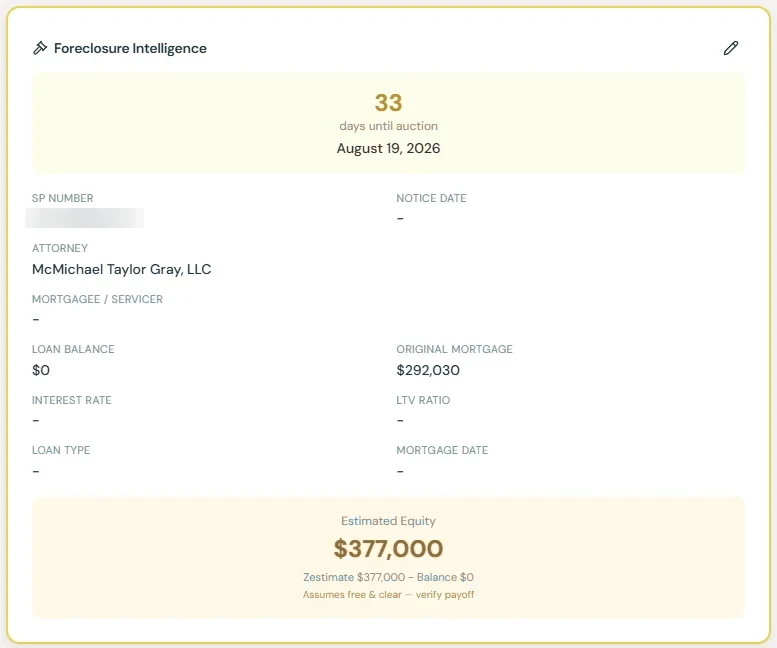
Real screen: the Foreclosure Intelligence card on a delivered record in ForesightCRM. The auction countdown and the foreclosure attorney sit on the lead, so you know the date before you ask question 15.
The bottom line on questions to ask motivated sellers
The questions to ask motivated sellers are not secret. The order is what works: earn the time, learn why, then the house, the money, the timing, and who signs, and end with a walkthrough on the calendar. Ask plainly, take no for an answer, and write down every answer while the seller is still talking.
If you want the dialer, recordings, and lead history in one place while you run these calls, start the 14-day Foresight trial and try them on your own list.
ForesightCRM is our product. Foresight claims are from our power dialer, AI Voice Agent, features, and pricing pages as of November 26, 2026. Rules and resources (47 CFR 64.1200, the CFPB, and the FCC) are linked where cited and were checked the same day. If something has changed, tell us and we will correct it.
Changelog: November 27, 2026, published.