
Operators tell me a version of the same story on calls. They go to the county website by hand, and the foreclosure records they find show up about 20 days before auction. One of them put the cost plainly: they were "missing four months of opportunity window." If you want to know how to find foreclosure leads before auction, that gap is the whole game.
The auction list is the last public record in a foreclosure, not the first. In many states, a court filing or a recorded notice shows up months earlier. This playbook walks the timeline by foreclosure type, shows where each record lives, and compares pulling by hand, buying a list, and paying for a daily feed.
I run a wholesale operation, and ForesightCRM is our product. I will tell you where our own data is strong and where coverage is still thin. Every statute and number below is linked to its source and was checked on September 17, 2026.
Stage one: missed payments and the 120-day rule
The rule is 12 CFR 1024.41(f)(1). The exceptions are a due-on-sale violation or a servicer joining another lienholder's foreclosure. The CFPB's plain-English version: except in rare cases, a servicer cannot start the foreclosure process until at least 120 days after the borrower becomes delinquent.
After that, states split into two paths. A judicial foreclosure runs through a lawsuit. A non-judicial foreclosure is one where the lender forecloses without first getting a court order, using a power-of-sale clause in the mortgage or deed of trust (Cornell LII).
Volume is rising. ATTOM counted 164,566 U.S. properties starting foreclosure in the first half of 2026, up 18 percent from a year earlier, and homes foreclosed in Q2 2026 had spent an average of 563 days in the process (ATTOM, July 16, 2026). In July 2026 alone, 26,648 properties started the process, and one in every 3,603 U.S. housing units had a foreclosure filing (ATTOM, August 27, 2026).
Show the numbers
| Value | |
|---|---|
| Texas, shortest | 155 days |
| U.S. average | 563 days |
| Louisiana, longest | 3,491 days |
Source: ATTOM 2026 midyear foreclosure market report, July 16, 2026, checked September 17, 2026
Judicial vs non-judicial foreclosure timeline, record by record
Here are five states side by side. They show the shape of each path. They are not a legal calendar for your county.
| State and path | First public record | Auction notice | How much earlier the first record can be |
|---|---|---|---|
| California, trustee sale | Notice of default, recorded with the county recorder (Civ. Code 2924) | Posted, published, and recorded at least 20 days before sale (Civ. Code 2924f) | At least 3 months, because 3 months must pass after the notice of default before notice of sale |
| Texas, non-judicial sale | Often the sale notice itself; the default notice goes to the borrower by certified mail with at least 20 days to cure (Prop. Code 51.002) | Filed with the county clerk and posted at the courthouse door at least 21 days before sale | Often little from public records alone |
| Florida, court case | Lawsuit and notice of lis pendens in the county's official records (Fla. Stat. 48.23) | Sale set 20 to 35 days after judgment; notice runs 2 consecutive weeks (Fla. Stat. 45.031) | The length of the lawsuit, which no statute fixes |
| North Carolina, power of sale with a clerk hearing | Notice of hearing filed with the clerk of court (G.S. 45-21.16) | Posted at least 20 days before sale; published 2 successive weeks (G.S. 45-21.17) | The hearing process, plus a 10-day upset bid period after the sale (G.S. 45-21.27) |
| South Carolina, court case | Notice of pendency filed with the county clerk (S.C. Code 15-11-10) | Sale after judgment | The length of the lawsuit, plus 30 days of open bidding after sale when a deficiency judgment is sought (S.C. Code 15-39-720) |
That table is where "four months" comes from. In California, the notice of default must sit at least three months before the notice of sale can go out, and the sale notice only has to appear 20 days before the auction. If you only watch sale notices there, you start with about three weeks instead of about four months.
Three months is drawn as 90 days, and real cases can take longer than these minimums.
Show the numbers
| Starts | Ends | |
|---|---|---|
| Missed payments, not yet public | 0 days | 120 days |
| Notice of default, 3-month wait | 120 days | 210 days |
| Notice of sale to auction | 210 days | 230 days |
Source: 12 CFR 1024.41(f) and Cal. Civ. Code 2924 and 2924f, checked September 17, 2026
Texas is the opposite case. The statute sends the default notice to the borrower by certified mail, and that subsection does not require filing it with the county, so the first public record you can pull is often the sale notice. ATTOM's Q2 2026 data had Texas at the shortest average foreclosure timeline in the country, 155 days, and Louisiana at the longest, 3,491 days (ATTOM midyear report).
The end of the timeline matters too. Florida lets the owner redeem until the clerk files the certificate of sale, or a later time set in the judgment (Fla. Stat. 45.0315). In North Carolina, the owner can still pay off the debt until the upset bid period ends (G.S. 45-21.20).
Where each pre-foreclosure record lives
- County recorder or official records. Notices of default in California. Lis pendens in Florida, which only operates against the property once it is recorded in the county's official records.
- Clerk of court and court dockets. Complaints and judgments in judicial states, and North Carolina's notice of hearing. South Carolina's notice of pendency is filed with the clerk too.
- County clerk and courthouse postings. Texas sale notices, filed with the county clerk and posted at the courthouse door.
- Newspapers and public notice sites. California sale notices run once a week for three weeks. North Carolina requires two successive weeks in a qualified local paper. Florida allows a newspaper or a public website.
- Attorney and trustee sale sites. Late-stage sale lists. Foresight Data, for example, describes pulling attorney sale sites along with county filings and tax rolls.
Probate filings live in a different court with a slower clock. Our probate CRM guide covers that side.

Sale notices are the easiest foreclosure records to find, and the latest ones to appear. Illustrative scene, not a ForesightCRM screenshot.
How to find foreclosure leads before auction: by hand, a list, or a feed
| By hand | List or data tool | Daily county feed | |
|---|---|---|---|
| Cost | Your hours, or a VA's | Subscription, for example PropertyRadar from $119/mo or LeadCruncher data from $60/mo | Foresight Data: $75 per county per month |
| How early | As early as the county publishes | Depends on which records the vendor tracks | Depends on which record types your county has |
| Main risk | Missed days and typos, one county at a time | You may still skip trace, import, and dial somewhere else | Coverage varies by county |
| Best for | One or two counties and a tight budget | Many counties and a team that already has a CRM | Operators who want records in the pipeline every morning |
PropertyRadar. Its foreclosure page tracks lis pendens, judgments, and sheriff sales on the judicial side, and notices of default, substitutions of trustee, and trustee sale notices on the non-judicial side. Auction tracking covers 8 western states and rechecks sales at least every 15 minutes on sale day. As of September 17, 2026, plans are $119, $249, and $599 per month with a 5-day free trial. Our PropertyRadar comparison goes deeper.
LeadCruncher. Its pricing page lists Assessors Data at $60 per month as of September 17, 2026, including 1.4 million plus pre-foreclosure records (NOD and lis pendens), daily data updates, and a Triple Dialer with 1,000 calling minutes a month.
Foresight Data. The ForesightCRM homepage advertises foreclosure data from county sources and trustee sale notices, checked daily, and the live county feed showed 1,322 counties live in September 2026. Foresight Data prices the feed at $75 per county per month. Here is the honest part: coverage of early court filings like lis pendens varies a lot from county to county, so check yours at getforesightdata.com before you buy. If your county does not have early filings yet, a feed will not close the four-month gap there, and a hand pull of the clerk's docket might.
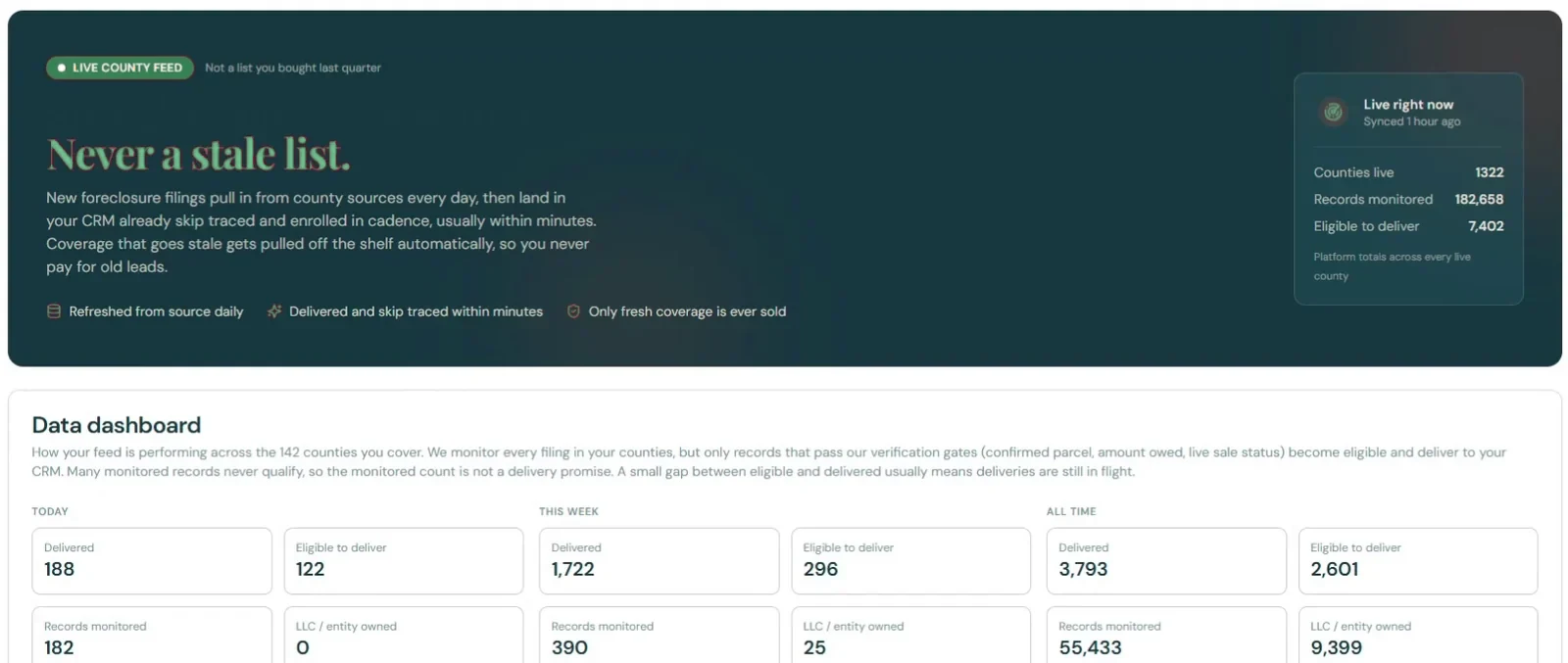
Real screen: the Foresight Data page in September 2026, a live county feed showing 1,322 counties live and 182,658 records monitored, plus the day's delivered and eligible counts.
Work the lead before the auction clock runs out
The ForesightCRM foreclosure suite, on Growth and up, is built around this clock. The timeline on that page runs lis pendens, notice of sale, auction, upset-bid window, and redemption ends. It adds auction countdowns on every lead, the North Carolina upset-bid window, attorney and hearing data, and automatic notice imports.
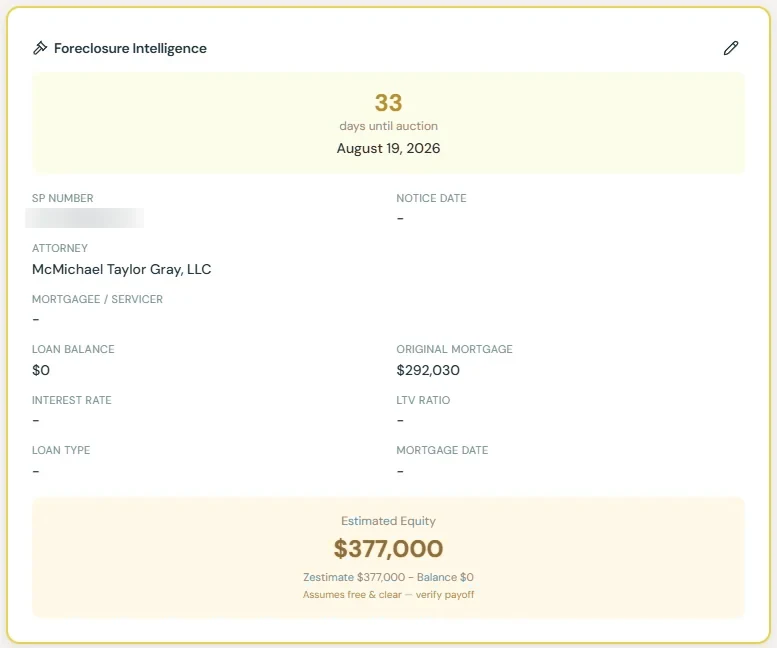
Real screen: the Foreclosure Intelligence card on a delivered record, with 33 days until auction, the foreclosure attorney, and $377,000 of estimated equity.
The legal side is real. California's foreclosure consultant law covers anyone who offers, for pay, to stop or postpone a foreclosure sale or save a home from foreclosure (Civ. Code 2945.1). Its equity purchaser law opens with a finding that homeowners in foreclosure "have been subjected to fraud, deception, and unfair dealing by home equity purchasers" (Civ. Code 1695). Minnesota regulates equity purchasers who take title through a property reconveyance (Minn. Stat. 325N.10). Check whether your state has similar rules before you make an offer.
When you are ready to write the first message, our pre-foreclosure text message scripts are a starting point. If you are still choosing the software to run this loop, our foreclosure CRM buying guide compares the options with sources.
The bottom line: how to find foreclosure leads before auction
How to find foreclosure leads before auction comes down to one habit: watch the first public record, not the last one. In a California-style trustee state, that is the notice of default. In a judicial state, it is the lawsuit and the lis pendens. In a Texas-style state, the sale notice may be most of the public record you get, so speed matters more than lead time.
Pull by hand if you work one county and have the hours. Buy a list if you work many counties and already have a CRM. Use a daily feed if you want records in your pipeline every morning, after you confirm your county has the early filings you want.
If you want those records, a power dialer, and the auction clock in one login, start the 14-day ForesightCRM trial. A card starts it, and nothing is charged until the trial ends.
ForesightCRM is our product. Foresight claims are from getforesightcrm.com, getforesightdata.com, and our foreclosure feature page as of September 17, 2026. Statutes, CFPB rules, ATTOM data, and PropertyRadar and LeadCruncher pricing were checked the same day and are linked above. This is not legal advice. If something has changed, tell us and we will correct it.